
Fragmented reference data
NDC product masters, manufacturer and customer contracts, and GPO rosters sat across separate systems. Analysts reconciled them manually before making a decision.
Explore how governed data engineering and supervised AI agents can support pharmaceutical pricing, contract checks and approved ERP updates. Outcome figures are illustrative until validated.
Explore the case studyTechTiera’s case study describes a governed, multi-agent pricing advisory platform for a large U.S. pharmaceutical distributor—connecting contract intelligence, pricing recommendations and approved ERP execution.
The engagement spans advisory, architecture, build and production rollout. It brings AI and data engineering into a single operating model, with contract checks and human oversight built into the decision process.
Client identity is confidential. Financial and performance figures in the supplied source material are illustrative until validated. This page preserves that qualification throughout.
| Client | One of the large pharmaceutical distributors in the U.S. |
|---|---|
| Industry | Healthcare, life sciences and pharmaceutical wholesale distribution |
| Business function | Pricing, contract administration, revenue assurance |
| Engagement type | Advisory, architecture, build and production rollout |
| Platform | Databricks Data Intelligence Platform: Delta Lake, Unity Catalog, Agent Bricks / Mosaic AI Agent Framework, Genie, Vector Search, MLflow and Model Serving |
| Core outcome | An agent-orchestrated, auditable workflow that publishes approved prices to ERP through an integration layer |
In pharmaceutical distribution, small pricing discrepancies can accumulate across high-volume transactions. The client needed faster decisions with evidence behind every price.
NDC product masters, manufacturer and customer contracts, and GPO rosters sat across separate systems. Analysts reconciled them manually before making a decision.
Contract changes and roster updates were processed in batch. Mis-priced transactions could surface weeks later in chargeback reconciliation or audit.
Eligibility mismatches, expired contract tiers, duplicate chargebacks and off-contract sales were difficult to detect across high-volume flows.
Every effective price needed a link to its contract, policy and approver. Manual processes made that evidence costly to assemble.
The condition was clear: AI recommendations needed enterprise security, explicit approval controls and a traceable path to execution.
We treated this as a change to the pricing operating model. Business, risk and technology leaders agreed the criteria for each stage before the next began.
| Phase | What we did | Gate to proceed |
|---|---|---|
| 1. Diagnose | Mapped the price-to-cash value chain. Quantified leakage hotspots and listed every pricing decision, its owner and its policy constraints. | Business case and a prioritized set of agent use cases signed off |
| 2. Design | Defined the target architecture, agent roles, human-in-the-loop checkpoints and governance model on Databricks. Aligned it with enterprise security, legal and compliance. | Architecture and control framework approved by risk and IT security |
| 3. Build and prove | Built the data foundation and each specialist agent. Ran them in advisory (shadow) mode against live pricing activity and measured them with automated evaluation. | Agent accuracy and compliance thresholds met in shadow mode |
| 4. Industrialize | Promoted the orchestrated workflow to production model serving, connected execution to ERP, and set up monitoring and operating handover. | Production go-live and run-state ownership transferred |
Two design choices shaped the delivery. Every agent started as an advisor: it recommends, a person approves, and autonomy increases only after evaluation and business sign-off. Unity Catalog governs access to platform assets; application controls enforce pricing rules, approval limits and permitted ERP actions.
A unified data foundation feeds a supervised workflow. Each agent has a specific task; recommendations return through validation and approval before they reach ERP.
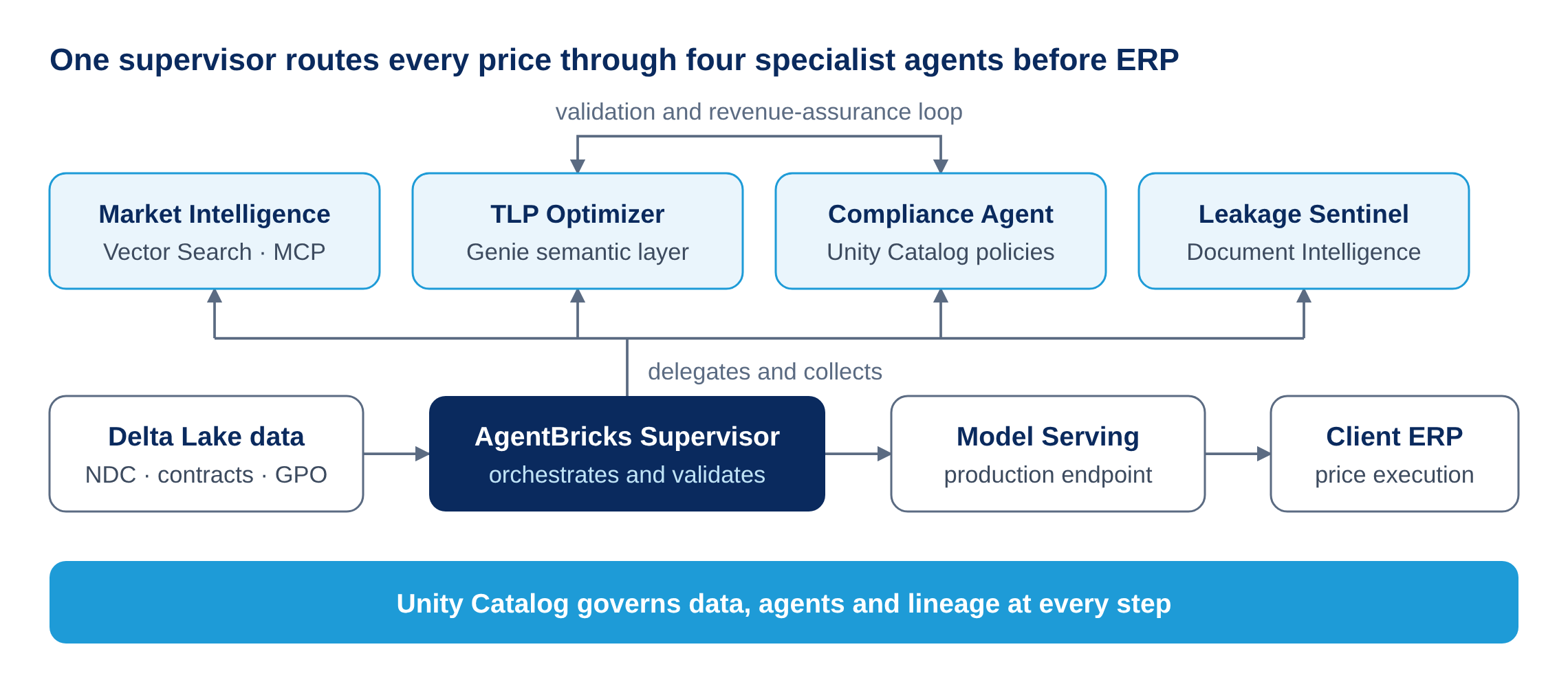
Architecture reading note: the source diagram uses “AgentBricks Supervisor” and “Genie semantic layer.” Genie provides governed data analysis; custom logic handles optimization and pricing rules. The ERP arrow includes an authorized integration and approval layer. Native data lineage is extended with execution and transaction logs.
Data foundation. National Drug Code (NDC) product masters, contracts and group purchasing organization (GPO) rosters land in Delta Lake as governed reference tables. Quality checks reconcile product identifiers, contract dates, membership and eligibility. Configured ingestion and tool calls use encrypted transport and scoped identities.
Explore the responsibilities of each agent, then review the complete mapping from business role to Databricks capability.
Assembles relevant market, competitor and manufacturer signals so a pricing recommendation starts with context.
Control: retrieved evidence must be attributable and available to the requesting identity.
| Agent | Role in the pricing decision | Databricks capability |
|---|---|---|
| Market Intelligence Builder | Assembles market, competitor and manufacturer signals as context for each pricing decision | Vector Search retrieval; authorized Model Context Protocol (MCP) tools |
| TLP Optimizer | Produces recommendations using contract tiers, margin targets and business rules; Genie supports natural-language analysis of governed pricing data | Databricks Genie over curated Unity Catalog data, with custom pricing and optimization logic |
| Compliance Agent | Checks each recommendation against contract terms, GPO eligibility and pricing policy before it goes further | Custom contract and pricing-policy checks; Unity Catalog governs access to data and functions |
| Leakage Sentinel | Extracts terms from contract documents and flags eligibility mismatches, expired tiers and off-contract pricing | Unity Catalog; document parsing and information extraction |
Orchestration and execution. A supervisor sequences the specialist agents and combines their outputs. The optimizer’s recommendation returns through contract and policy checks until it passes or is escalated to a pricing analyst. Model Serving exposes the decision endpoint; a separately authorized application/API integration publishes approved prices to ERP and records the execution response.
Genie gives analysts a natural-language interface to curated enterprise data. In a pharmaceutical pricing workflow, it supports questions about contracts, eligibility and commercial exposure.
TechTiera connects that analysis to custom pricing logic, tested business rules and an explicit approval process. Genie’s role is data exploration and analysis within the wider agentic workflow.
Discuss a Genie use case →“Which contract tiers expire in the next 30 days?”
“Where do GPO eligibility records conflict with applied prices?”
“Which price changes need an analyst’s review?”
Examples describe possible queries, not recorded client conversations or generated results.
The control model connects source data, tool activity, policy checks, approvals and execution records. Business owners retain authority over approval thresholds.
One governance layer. Unity Catalog controls access to registered data, models and functions. Agent and tool permissions are configured explicitly, alongside application controls for contract eligibility and pricing policy.
Security context passing. User-delegated authorization is configured where supported. Service identities receive narrowly scoped permissions, with explicit checks at each tool and integration boundary.
End-to-end evidence. Unity Catalog data lineage, MLflow execution traces, approval records and ERP transaction identifiers are correlated to reconstruct each decision. This evidence chain requires application instrumentation beyond native table lineage.
Encrypted data in motion. All agent-to-data and agent-to-agent traffic runs over TLS-encrypted streams.
Automated agent evaluation. MLflow evaluation and business-specific test cases assess accuracy, groundedness and pricing-policy adherence before release and during operation. Failed thresholds trigger review before further promotion.
Human in the loop by design. Thresholds decide what is auto-approved, what is routed to an analyst and what is blocked. Pricing leadership owns those thresholds, not the technology team.
Controls support the client’s governance requirements. This commercial pricing case study does not claim clinical validation or a regulatory certification.
All figures below are retained from the source document. They are not independently verified client results or a promise of future performance.
| Outcome area | Before | After (first 12 months) |
|---|---|---|
| Pricing cycle time | 5–10 business days from contract change to effective price | Under 24 hours for 90% of price changes; ~85% faster |
| Revenue leakage | Found after the fact in chargeback reconciliation and audits | ~$27M a year in leakage flagged before execution; ~$16M recovered in year one |
| Compliance exceptions | Manual sampling of about 5% of transactions | 100% of agent-recommended prices policy-checked before ERP; 60% fewer exceptions |
| Recommendation quality | No consistent baseline | 94% of recommendations accepted by analysts without change in shadow mode |
| Analyst productivity | About 65% of analyst time spent reconciling data | ~45% of analyst effort moved from reconciliation to pricing strategy |
| Audit readiness | Two to three weeks to assemble evidence for each review | Lineage from source data to ERP transaction on demand; evidence prepared in under 2 days |
| Scalability | Fixed nightly batch windows | Handles 3x peak transaction volume with no added headcount |
The source estimates approximately $16M recovered in year one separately from $27M in annual leakage flagged. Identification and recovery are different measures. The source material’s cycle-time ranges and “~85% faster” estimate require a reconciled baseline before publication as verified outcomes.
Beyond the numbers, the client gained a reusable pattern. The same supervisor, governance layer and evaluation harness can take on new agents, such as rebate, chargeback or demand-sensing agents, without rebuilding the foundation.
A reusable pattern for enterprise AI begins with decision ownership and continues through evaluation, integration and ongoing operations.
Start with the decision, not the model. We listed every pricing decision, its owner and its policy constraints before choosing any technology. Agents were then designed around those decisions.
Specialize agents, centralize control. Narrow agents are easier to test, explain and trust. A single supervisor keeps accountability clear.
Govern access centrally and validate decisions explicitly. Unity Catalog permissions and lineage work alongside tested pricing rules, approval records and integration logs to make decisions explainable and auditable.
Earn autonomy with evidence. Shadow mode and automated evaluation gave pricing, compliance and finance leaders hard evidence before any agent touched a live price.
Design for the run state from day one. MLflow tracing, evaluation and release workflows, together with monitored serving, supported a repeatable transition to production.
| Layer | Components |
|---|---|
| Data foundation | Delta Lake reference data (NDC master, contracts, GPO rosters); TLS-encrypted streaming ingestion |
| Governance and security | Unity Catalog access policies, lineage and governed functions; explicit authorization and application audit records |
| Agents and orchestration | Supervisor-led orchestration (Agent Bricks / Mosaic AI Agent Framework); Vector Search; MCP; Genie; document parsing and information extraction |
| MLOps and quality | MLflow tracing, evaluation and release workflows; agent-quality monitoring |
| Serving and integration | Databricks Model Serving; application/API integration for approved ERP write-back; monitoring |
The stack reflects the supplied engagement narrative. Agent Bricks and Genie product names and deployment options have evolved; new implementations should use the currently supported capabilities for the selected cloud and region.
TechTiera brings advisory, data engineering, AI development and managed services into the same delivery conversation—from the first use case to ongoing support.
Lakehouse architecture, ingestion, data quality, curated business data and governance for analytics and AI.
Explore data engineering →Genie configuration, specialist agents, evaluation, approval controls and integration with enterprise systems.
Explore agentic AI services →Commercial data, contracts and operational workflows shaped around life sciences and healthcare requirements.
Explore industry services →TechTiera Corporation is a Tampa, Florida–based technology services firm. We help enterprises in life sciences, healthcare, distribution and financial services turn data and AI into governed, production-grade business outcomes. Our teams cover advisory, data engineering, AI and agentic systems, and managed services, from strategy through run state.
Practical answers for life sciences, healthcare and pharmaceutical commercial teams.
A supervisor can coordinate market research, governed pricing analysis, eligibility checks and leakage detection. In this workflow, approved decisions pass through a controlled ERP integration. Human review, tested business rules and audit evidence define when a recommendation can become an effective price.
Genie supports natural-language questions over curated enterprise data, such as contracts, pricing history and eligibility tables. Analysts configure business context and trusted examples. Custom optimization logic, policy checks and approval workflows remain separate responsibilities; Genie alone is not a pricing engine.
Unity Catalog provides access controls, asset governance, lineage and audit information for registered data and AI assets. Pricing-policy checks, human approvals and ERP execution records complement those controls. A platform configuration alone does not establish regulatory compliance.
The governed data and supervised-agent pattern can inform contract analytics, chargeback review, rebate analysis and commercial revenue assurance. These are potential extensions, not additional deployments claimed in this case study. Patient-facing or clinical uses require a separate risk and validation assessment.
TechTiera supports use-case discovery, lakehouse data engineering, Databricks architecture, Genie configuration, agent workflow development, governance, evaluation, enterprise integration and ongoing operations. The engagement begins with the business decision, data readiness and measurable acceptance criteria.
No. The supplied source material states that its figures are for illustration until validated. The page retains that qualification beside the outcome summaries and the full results table. Confirmed measurement methods, baselines and client publication approval are needed before presenting them as verified results.
Case narrative, diagram and outcome figures: supplied TechTiera source material.
Genie AgentsAgent developmentUnity CatalogDocument processingExplore AI decision controls and the data engineering services behind a governed analytics program.
Find more projects with a related industry, project type or technology focus.
ENTERPRISE CLIENTS RELY ON TECHTIERA SERVICES