Documentum to Databricks integration for oil and gas AI
This Documentum to Databricks integration gave an oil and gas company a maintained content foundation for AI. The client already had a GenAI agent on Databricks. Its controlled procedures and standards lived in Documentum, while the AI team relied on a small, manually copied sample.
TechTiera delivered the integration between those environments: loading the agreed content estate, scheduling document and metadata updates, and making the handover traceable through reconciliation, change records and monitoring.
The client’s AI team gained a governed, regularly refreshed copy of its agreed Documentum content in Databricks, while retaining ownership of retrieval and agent behavior.
Why the AI team needed a reliable content feed
Engineers, operators and HSE teams work with controlled policies, SOPs, technical standards and guidelines. Connecting those documents to AI required more than a one-time export.
Content outside the lakehouse
Documentum held the authoritative files and Oracle held metadata. The manually copied sample did not represent the agreed production estate.
Changes after the initial load
Revisions, new versions, reclassifications and withdrawals had to reach downstream teams on a repeatable schedule.
Integrity that could be checked
Native files needed to arrive without conversion, OCR or cleansing. File counts, checksums and metadata coverage needed separate verification.
A firm source boundary
The integration could not change Documentum configuration, schema or search behavior, or write content back into the repository.
Overlapping delivery scope
Search, embedding and agent work in the original SOW overlapped with the client AI team’s responsibilities. The integration needed a clear owner and endpoint.
Agree the boundary. Then build the connection.
TechTiera brought the ECMS and Data & AI Factory teams together in two alignment sessions. The resulting scope definition gave each team a clear responsibility—from source interfaces to the governed data landing in Unity Catalog.
Chunking, embeddings, search, query-time entitlement filtering and agent development remained with the client. TechTiera focused on the content and metadata pipelines, operational controls and evidence needed for acceptance.
| Phase | What TechTiera did | Key output |
|---|---|---|
| 01 / Align | Ran two alignment sessions with ECMS and the Data & AI Factory. Agreed what TechTiera would deliver and where the client’s AI responsibilities began. | Agreed scope definition and responsibility boundaries |
| 02 / Design | Defined change-detection and document-retrieval interfaces with ECMS. Agreed metadata, change-log and recovery requirements with the AI team. | Interface contract, metadata schema and pipeline design |
| 03 / Build | Loaded the agreed initial extract and metadata. Implemented scheduled document and metadata updates, configurable retention and operational alerts. | Content and metadata pipelines on a nightly/daily schedule |
| 04 / Validate | Reconciled file counts and checksums, assessed metadata coverage and tested changes, recovery and repeat runs. Supported the client’s UAT. | Reconciliation, metadata completeness and UAT records |
| 05 / Handover | Provided daily load summaries, named alert recipients and an operating handover. | Defined schedules, recovery steps and alert paths |
How TechTiera connected Documentum and Databricks
Source interfaces feed TechTiera’s pipelines. Native files land in a Unity Catalog Volume; metadata and change events land in Delta tables. The client’s AI team consumes those outputs.
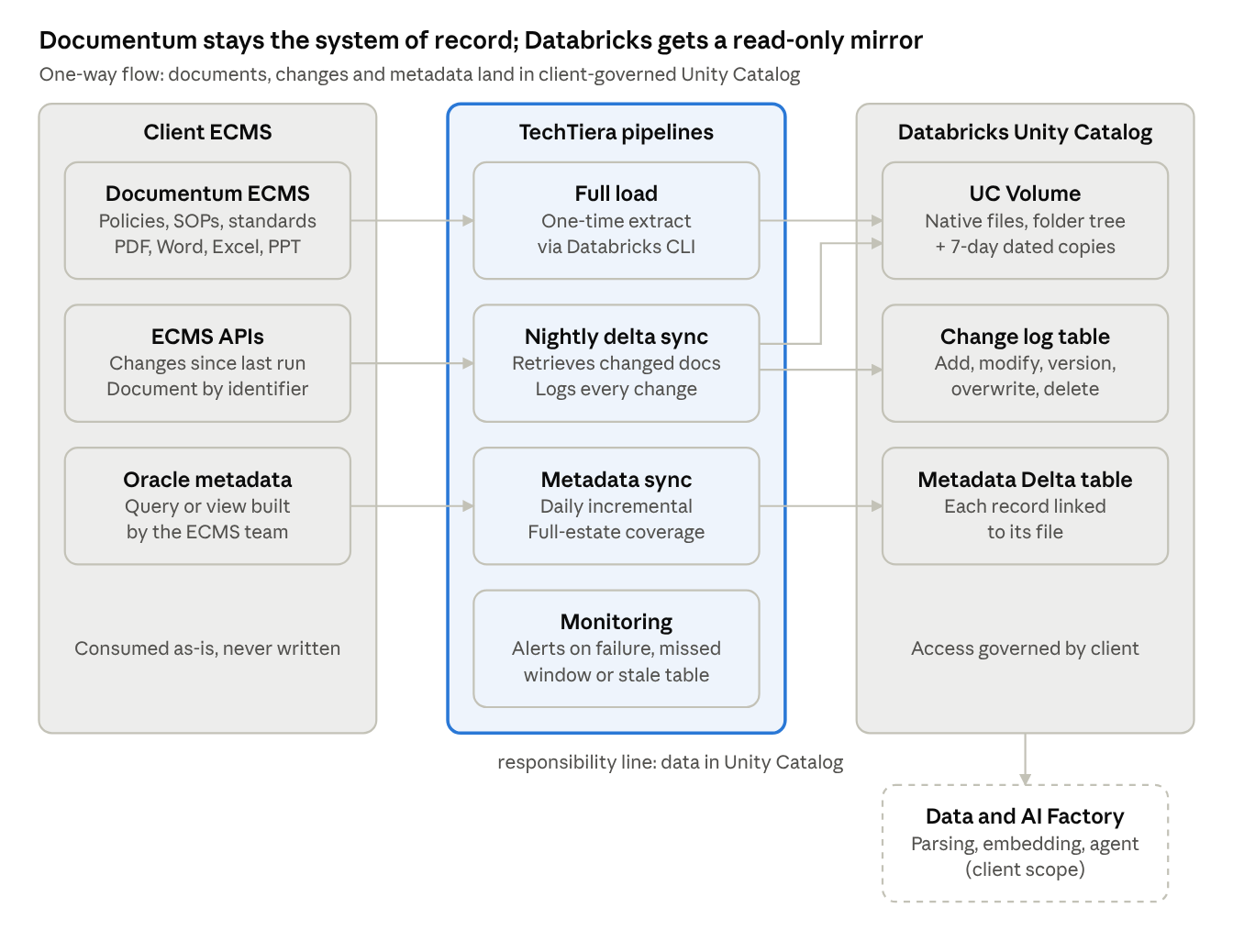
Content and metadata synchronization pipelines
Select a delivery component to see what it does and where its responsibility ends.
Load native content and metadata.
The ECMS team supplied the agreed extract in a shared directory. TechTiera used the Databricks CLI to load native files into a Unity Catalog Volume, preserved the folder structure and loaded the initial metadata into a Delta table.
Acceptance evidence: source and target file counts, checksum reconciliation and metadata coverage.
A change log for downstream consumers.
Each run records document identifiers, timestamps and change types—added, modified, overwritten, new version or deleted. These records let the AI team identify withdrawn or superseded content and update its own indexes and retrieval rules.
Recording a deletion is distinct from proving physical target deletion or suppression in every downstream application. Those behaviors need an agreed lifecycle and consumer design.
Access controls, integrity and delivery ownership
One-way source access
Pipelines read the agreed source interfaces. They do not create, modify or delete content in Documentum. The repository remains authoritative.
Native file integrity
Files are loaded without format conversion, OCR, parsing or cleansing. Checksum reconciliation verifies transferred-file integrity; metadata completeness is assessed separately.
Client-governed target access
The client administers Unity Catalog permissions and service identities. The target mirror does not automatically reproduce Documentum ACLs or end-user entitlements.
A defined recovery window
Dated run artifacts support replay over a configurable window, seven days by default. This operational recovery setting is separate from source and target records-retention policies.
| Area | Accountable delivery owner | Responsibility |
|---|---|---|
| Source platform & interfaces | Client ECMS team | Documentum and Oracle operation, source extract, agreed APIs and metadata view |
| Integration & assurance | TechTiera | Load and synchronization pipelines, change records, reconciliation, monitoring and handover |
| Target access & governance | Client Data & AI Factory | Unity Catalog permissions, service identities and access policy for the target data |
| AI consumption & answers | Client Data & AI Factory | Parsing, chunking, embeddings, retrieval, query-time entitlement filtering, agent behavior and answer-quality evaluation |
What changed for the oil and gas AI team
The completed work replaced a manual sample-copying process with scheduled content and metadata feeds, supported by reconciliation, change records and operational monitoring.
From sample to agreed estate
Initial files and metadata made available in the lakehouse.
From manual to scheduled
Nightly document changes and daily metadata updates.
From overlap to clear ownership
Integration delivery separated from AI consumption.
| Impact area | What changed | Delivery evidence / boundary |
|---|---|---|
| Content available for AI | Replaced the manually copied sample with the agreed Documentum content estate and its metadata in Databricks. | Initial-load reconciliation and metadata completeness reports |
| Scheduled refresh | Automated nightly document updates and daily metadata synchronization, subject to successful runs and source availability. | Job schedules, daily summaries and failure/staleness alerts |
| Version and withdrawal visibility | Recorded added, modified, overwritten, new-version and deleted events for downstream processing. | Per-document, per-run change log; consumers use these events to suppress withdrawn or superseded content |
| Metadata continuity | Updated classification and lifecycle metadata even when a document’s file had not changed. | Metadata pipeline and file-linked records covering the agreed estate |
| Clearer delivery scope | Removed overlapping search, embedding and agent-development work from TechTiera’s integration scope. | Agreed scope definition and ownership boundaries |
| Source platform preserved | Implemented a one-way integration without pipeline write-back or changes to Documentum configuration, schema or search behavior. | Read-only source interfaces and agreed non-intrusion boundary |
| Operational recovery | Added alerts, daily summaries and date-range replay using retained run artifacts within the configured recovery window. | Monitoring and re-run procedures; seven-day default artifact retention |
The outcomes above describe the integration delivered. They do not represent measured improvements in AI answer quality or financial performance.
Where Genie and agentic AI could fit next
This engagement delivered the content connection. The client retained responsibility for how its GenAI agent used that content.
For a new engagement, TechTiera can assess the broader path—from Documentum integration and data engineering to retrieval, Genie enablement and supervised agent workflows—against the customer’s access, lifecycle and evaluation requirements.
Explore AI and agentic AI services →Genie for governed data questions
Curated metadata and operational tables could support natural-language analysis of classifications, synchronization exceptions or coverage.
Retrieval over controlled content
Parsing, chunking and search would need their own design, access checks, withdrawal handling and evaluation before documents support answers.
Supervised agent workflows
Task-specific agents could be evaluated with defined tools, approval boundaries and traceable actions. These were not delivered in this integration.
Adapting the integration to regulated industries
Many organizations keep authoritative documents in an ECM platform while developing analytics and AI in a lakehouse. The integration pattern can be adapted after assessing each customer’s repositories, permissions, lifecycle rules and operating needs.
Oil & natural gas
The completed engagement
Content context
Policies, operating procedures, HSE guidance and engineering standards for upstream teams.
Delivery focus
Scheduled document and metadata feeds give the client’s AI team a maintained content foundation.
Banking
A potential application
Content context
Operating procedures, lending policies, compliance manuals and controlled service guidance.
Delivery focus
Assess business-unit entitlements, legal holds and source-to-target access rules before designing AI consumption.
Financial services
A potential application
Content context
Risk policies, internal control documents, product guidance and finance operating manuals.
Delivery focus
Define data residency, retention, sensitive-content boundaries and evidence requirements for each repository.
Insurance
A potential application
Content context
Underwriting manuals, claims procedures, policy wordings and internal operating guidance.
Delivery focus
Validate product/version applicability and role-based access before retrieval or agent workflows use the content.
Banking, financial services and insurance examples describe potential adaptations. This case study reports one completed oil and gas engagement.
Documentum expertise and data engineering delivery
TechTiera combined Documentum knowledge with data engineering delivery. The team accounted for document versions, lifecycle changes and metadata-only updates when defining the integration.
In this engagement, the difference came from agreeing interfaces early, defining reconciliation before the build and working within the client’s existing Unity Catalog governance.
Documentum and Databricks integration FAQs
What the integration delivered, how it stays current and where Genie and agentic AI could fit.
What did TechTiera deliver in this Documentum-to-Databricks case study?
TechTiera delivered the content integration and data engineering layer: an initial document and metadata load, nightly document synchronization, daily metadata updates, a change log, monitoring, reconciliation and operational handover. The client’s Data & AI Factory owned the AI agent and downstream retrieval.
Was this a Documentum migration or a Databricks integration?
It was a one-way integration that created a downstream copy. Documentum remained the system of record. The pipelines did not write back to Documentum, and the engagement did not retire or replace the repository.
How current is the Databricks copy of Documentum content?
Document changes were scheduled for nightly synchronization, with metadata updated daily. Freshness depends on successful jobs, source interfaces and availability. Monitoring identifies failed runs and stale data; the solution should not be described as real-time or always current.
Do Documentum permissions automatically carry over into Unity Catalog?
No. Unity Catalog governs access to the target volumes and tables according to the client’s configured permissions. Documentum ACLs and user-level entitlements do not automatically transfer simply because files are copied. Downstream access and query-time filtering require explicit design and client ownership.
Did TechTiera implement an agentic AI system or Databricks Genie in this engagement?
No. This engagement supplied the content foundation for the client’s existing GenAI agent. Agent development, embeddings, search and retrieval were outside TechTiera’s scope. Genie or additional agentic workflows could be assessed separately using the governed data and suitable access controls.
How could Databricks Genie use this content foundation?
Genie could support natural-language analysis of curated metadata and operational tables, such as synchronization exceptions or document classifications. Any document analysis would require a separately assessed configuration, supported capabilities and permission testing. A file mirror alone does not implement a Genie or retrieval solution.
Does the seven-day recovery window replace records retention?
No. The default seven-day window applies to dated synchronization artifacts used for operational replay. It is configurable and separate from source records retention, legal holds and the retention or deletion policies needed for the target mirror.
Can the same integration pattern support banking, financial services or insurance?
Yes, the pattern can be adapted following discovery and control design. Potential content includes banking procedures, financial control policies and insurance underwriting guidelines. These are potential applications, not additional client implementations claimed by this oil and gas case study.
About this case study
A completed TechTiera engagement for a multinational upstream oil and gas company. Client identity is confidential. The story covers content integration and data engineering; downstream AI remained client-owned.
Platform references: Unity Catalog Volumes · Genie Agents · Agent development