

OpenText VIM for SAP accounts payable automation in FMCG
Standardizing invoice workflows, resolving exceptions earlier and improving supplier payment visibility for a leading FMCG enterprise.
Explore the case study- traceability Visibility from receipt to posting
- Invoice
- exception resolution Discrepancies routed to the right resolver
- Earlier
- payment readiness Aging and discount deadlines in view
- Stronger
Project at a glance
- Industry
- FMCG / Retail
- Company
- Leading FMCG enterprise
- Platform
- SAP
- Technologies used
- OpenText VIM for SAP · SAP ERP
- Technology / sub-category
- OpenText Vendor Invoice Management for SAP (OpenText VIM)
- Services
- Enterprise Applications, Content & Document Management
Industry: FMCG / Retail · Platform: SAP
THE ENGAGEMENT
Bring invoice control into the SAP finance process.
TechTiera implemented OpenText Vendor Invoice Management (VIM) for SAP for a leading FMCG enterprise, replacing fragmented manual invoice handling with standardized workflows, role-based approvals and centralized invoice status visibility.
In a high-volume consumer goods business, invoice delays affect more than administrative throughput. They influence supplier confidence, payment timing and the finance team’s view of liabilities. The client needed a common process that would make incoming invoices traceable and give exceptions a clear route to resolution.
TechTiera connected the OpenText VIM implementation directly with the SAP ERP finance environment. The engagement combined process standardization, business rules, multi-level approval routing and operational visibility, helping the client improve processing efficiency and make better use of early-payment opportunities.
Illustrative consumer goods operations. Imagery represents the industry and does not identify the client.
THE BUSINESS CHALLENGE
Manual handling was slowing payments and obscuring liabilities.
The client’s supplier network generated a demanding AP workload. Fragmented intake, manual intervention and delayed approvals created friction for finance teams and vendors.
Supplier confidence
Payment delays and limited invoice status transparency weakened supplier relationships. AP needed a reliable way to see where invoices were waiting and move them toward resolution.
Processing cost and delay
Repeated manual handling and unresolved exceptions increased the effort required for each invoice. Slow routing also reduced the opportunity to approve invoices before early-payment discount deadlines.
Period-end visibility
Unapproved and in-flight invoices were difficult to track consistently. That limited the finance team’s visibility into pending liabilities during month-end and quarter-end accrual preparation.
TECHTIERA’S APPROACH
Standardize the process, then automate the handoffs.
TechTiera designed the implementation around the invoice lifecycle, with controls and visibility connected to the SAP finance core.
Standardized invoice intake and validation
TechTiera simplified invoice ingestion across supplier channels and established a common workflow for invoice handling. Standardization gave AP a more consistent starting point for validation and reduced the variation that had made manual processing difficult to manage.
The emphasis was on a traceable process from receipt onward: invoices could be monitored as they moved through checks, approvals and posting rather than disappearing into disconnected handling steps.
Business rules and exception resolution
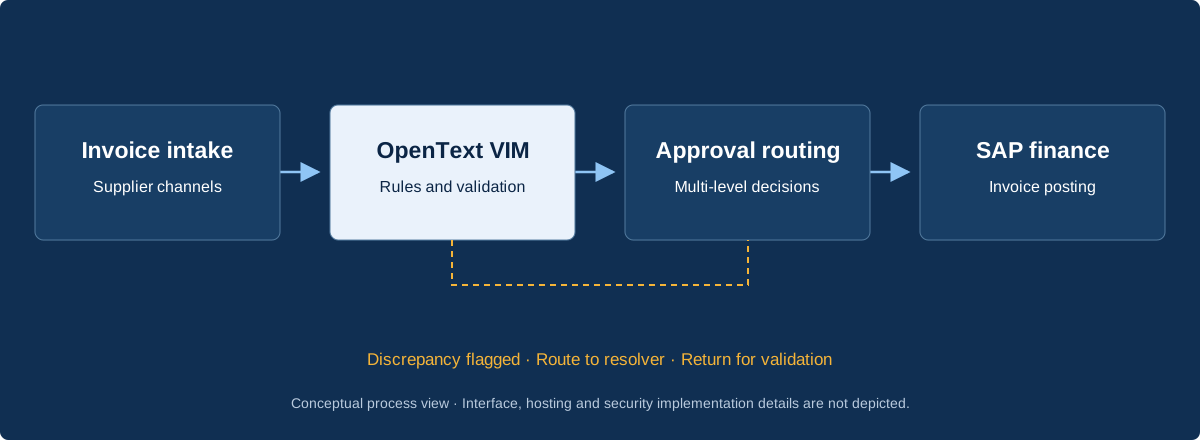
Business rules and exception-blocking mechanisms flagged discrepancies early in the process. Issues were directed to the appropriate resolvers, allowing the people responsible for a discrepancy to address it before it delayed the invoice further.
This approach focused manual attention where a decision or correction was needed. Exception handling became part of the controlled workflow rather than an informal activity outside it.
Role-based approval workflows in OpenText VIM
TechTiera configured dynamic, multi-level approval routing in OpenText VIM, integrated with SAP finance. The routing model connected invoice decisions with the relevant business roles and provided a consistent approval path.
Centralized dashboards and tracking capabilities gave AP teams and business approvers visibility into invoice status from receipt to posting. That shared view helped teams identify bottlenecks and respond to supplier inquiries with clearer information.
Accrual readiness and discount alignment
The solution made open and pending invoices more visible to finance, supporting month-end and quarter-end accrual preparation. The same operational view brought invoice aging and due dates into focus.
By aligning approvals with vendor discount deadlines, the client was better positioned to capture early-payment discounts. Payment execution remained a downstream finance activity; the VIM workflow improved the invoice readiness and visibility needed to support it.
PROCESS AND INTEGRATION
A visible route from invoice receipt to SAP posting.
The process view shows how standard handling and exception resolution support the invoice lifecycle. It is a conceptual workflow, rather than a specification of individual interfaces or capture products.
AP operations
Use centralized status tracking to identify invoices awaiting action and reduce repeated manual follow-up.
Finance control
Bring open and pending invoice information into accrual preparation and payment readiness reviews.
Supplier relationships
Provide clearer status information and support more timely approvals against agreed payment terms.
DELIVERED OUTCOMES
Better processing efficiency and a clearer view of invoices.
The engagement improved invoice processing, payment readiness and AP visibility. Its outcomes connect workflow changes with the practical needs of finance and supplier-facing teams.
| Priority | Outcome | Business value |
|---|---|---|
| Processing efficiency | Lower invoice processing cost and faster cycle times. | Standard workflows and earlier exception handling reduced avoidable manual effort. |
| Invoice traceability | Visibility and auditability from receipt to posting. | AP and business approvers gained a shared view of invoice progress. |
| Payment readiness | Fewer overdue invoices and improved discount realization. | Aging and due-date tracking supported timely approvals and early-payment opportunities. |
| Financial close | Improved visibility into open and pending liabilities. | Finance had a clearer basis for preparing period-end accruals. |
| Supplier experience | Stronger supplier relationships. | Clearer status and fewer payment delays reduced friction in vendor interactions. |
WHY THE APPROACH MATTERS
Connect AP automation to the decisions finance teams make.
The strength of the engagement was the connection between workflow automation and the day-to-day needs of AP. Intake standardization addressed how invoices entered the process. Business rules addressed what required correction. Role-based routing established who needed to act.
Invoice visibility then made those steps useful to finance and supplier-facing teams. For organizations evaluating OpenText VIM implementation services, this case illustrates the value of designing approvals, exception resolution, accrual visibility and payment readiness as one connected operating process.
Explore TechTiera’s OpenText expertiseYOUR QUESTIONS, ANSWERED
OpenText VIM for SAP
case study FAQs.
Direct answers for business and technology leaders.
What is OpenText VIM for SAP?
OpenText Vendor Invoice Management for SAP Solutions supports invoice processing within SAP-centered finance operations. In this engagement, TechTiera used it to standardize invoice workflows, apply business rules, route approvals and give AP teams invoice status visibility.
What did TechTiera implement for the FMCG client?
TechTiera implemented OpenText VIM integrated with SAP ERP, including standardized invoice intake, validation and exception blocking, multi-level role-based approvals, centralized tracking, accrual visibility and aging and due-date monitoring.
How did OpenText VIM improve invoice exception handling?
Business rules identified discrepancies early and routed them to the appropriate resolvers. This gave exceptions a defined place in the invoice workflow and helped prevent unresolved issues from becoming approval and posting bottlenecks.
How did the solution support early-payment discounts?
Invoice aging and due-date visibility helped AP prioritize approvals before vendor discount deadlines. The engagement improved the organization’s ability to capture early-payment discounts; it does not establish a universal discount rate or guaranteed savings amount.
How did AP automation help period-end accruals?
Centralized visibility into open, pending and unapproved invoices gave finance a clearer view of liabilities in progress. This supported month-end and quarter-end accrual preparation.
What measurable outcomes are provided in this case study?
The engagement describes reduced processing costs and cycle times, fewer overdue invoices, better discount realization and stronger traceability. It does not specify numerical improvement percentages, invoice volumes or a quantified savings amount.
Explore related expertise
Explore related case studies
Find more projects with a related industry, project type or technology focus.