

SAP xECM record book automation for oil and gas
Transforming Manufacturer’s Record Book assembly with SAP Extended ECM by OpenText, machine-learning-enabled ingestion and earlier quality review.
Explore the case study- previous turnaround MRB and final-invoice compilation
- 4 months
- new turnaround Reported compilation and delivery cycle
- 3 weeks
- pages per MRB Record books reaching this scale
- 5,000
Project at a glance
- Industry
- Oil & Natural Gas
- Region
- Middle East
- Company
- Major oil and gas infrastructure enterprise
- Platform
- SAP
- Technologies used
- SAP Extended ECM by OpenText · SAP ERP · ML-enabled ingestion
- Technology / sub-category
- OpenText Extended ECM (OpenText xECM)
- Services
- Enterprise Applications, Content & Document Management
Industry: Oil & Natural Gas · Platform: SAP
THE ENGAGEMENT
Make project documentation ready before closeout.
TechTiera redesigned the Manufacturer’s Record Book (MRB) lifecycle for a Middle East oil and gas infrastructure enterprise using SAP Extended ECM by OpenText, SAP integration and machine-learning-enabled document ingestion. Compilation and delivery of record books reaching 5,000 pages and their final invoices moved from four months to three weeks.
The client provided infrastructure, construction, piping, flow control equipment and electrical systems. Project completion depended on compiling a substantial body of quality and compliance documentation, including material test certificates and other project records.
An outdated archive and fragmented repositories made those records difficult to organize consistently. TechTiera established an authoritative content repository, aligned indexing and folder structures with SAP project hierarchies, and moved quality review into the document lifecycle so discrepancies could be addressed earlier.
Illustrative energy operations. Imagery represents the industry and does not identify the client.
THE BUSINESS CHALLENGE
Closeout delays began long before the final record book.
Records arrived over an extended project lifecycle and across inconsistent formats and repositories. The legacy approach made missing or incomplete documentation difficult to identify until compilation.
Four-month assembly cycle
Final invoice and MRB compilation could take up to four months, with record books reaching 5,000 pages. The delay held up project closeout and the associated commercial process.
Fragmented document sources
Certificates, test reports and project records were spread across disconnected locations without consistent formats or centralized enterprise access.
Late discovery of quality gaps
Manual tracking and long document lifecycles meant incomplete compliance records could surface late. Quality teams needed to validate records earlier rather than resolve every gap at the end.
TECHTIERA’S APPROACH
Build the record book throughout the project lifecycle.
TechTiera connected content architecture, SAP project context, digital ingestion and proactive quality assurance to improve the completeness and readiness of project records.
MRB lifecycle redesign and a shared repository
TechTiera redesigned the documentation process and implemented SAP Extended ECM by OpenText as the authoritative repository for project records. This replaced fragmented storage with a common content foundation for engineering, quality assurance and finance.
The design brought the documents needed for closeout into a controlled lifecycle, allowing MRB assembly to draw on organized records rather than a last-minute search across separate archives.
SAP context and cross-functional access
Document access was embedded within core SAP transactions and provided through a web interface for cross-functional teams. This allowed SAP users and other project participants to work with the same project records through their relevant access channels.
Automated folder structures and indexing rules followed SAP project hierarchies. Linking content organization to the project structure supported more consistent retrieval and assembly of the MRB.
Machine-learning-enabled ingestion
The implementation enabled digital ingestion of incoming certificates, test reports and project records using machine learning to support classification and metadata handling. This reduced dependence on manual paperwork and helped structure records as they entered the environment.
The machine-learning-enabled ingestion sat within the wider content process. It was complemented by quality review, allowing document discrepancies to be identified and resolved rather than assuming that classification alone established record completeness.
Proactive quality assurance
Quality Assurance teams gained review and validation gates as records entered the system. They could inspect the documentation, identify discrepancies and resolve issues during the document lifecycle.
This moved attention to record quality earlier in the process. By reducing late discovery of gaps, the redesigned workflow supported more timely MRB compilation and final-invoice delivery.
PROCESS AND INTEGRATION
Connect ingestion, SAP context and quality review.
This conceptual lifecycle shows how the solution organizes incoming records and supports review before MRB assembly. The specific machine-learning engine, interfaces and model configuration are not depicted.
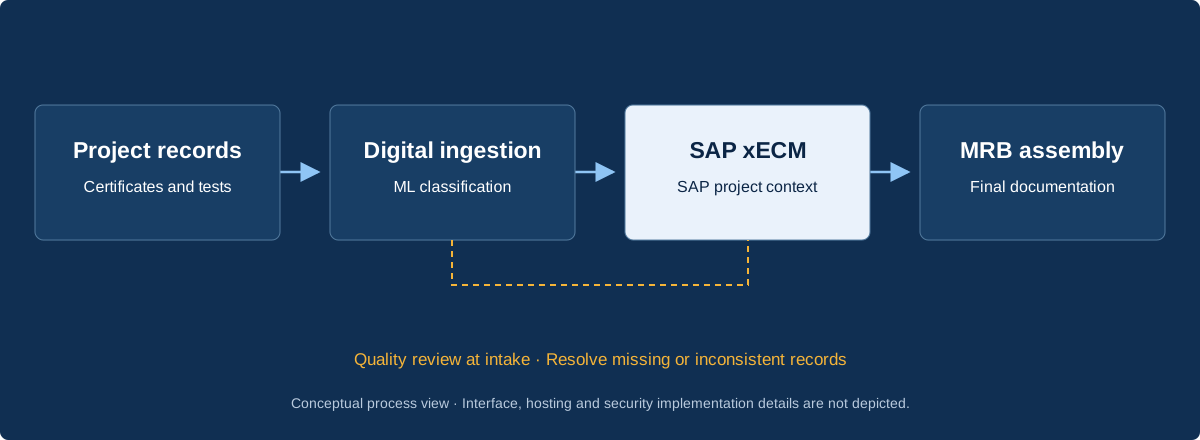
Engineering records
Organize certificates, test reports and project documentation in a shared repository linked to the project hierarchy.
Quality assurance
Validate records during the lifecycle and resolve documentation gaps earlier.
Project closeout
Assemble the MRB and final documentation from structured, reviewed content.
DELIVERED OUTCOMES
From a four-month compilation process to three weeks.
The project’s clearest result was the change in MRB and final-invoice turnaround, supported by an authoritative repository and earlier quality review across the document lifecycle.
Compilation and delivery
Compilation and delivery
| Priority | Outcome | Business value |
|---|---|---|
| Compilation and delivery | Turnaround reduced from four months to three weeks. | Project documentation and final invoices were ready sooner. |
| Document scale | MRBs reaching 5,000 pages supported in the redesigned lifecycle. | Large record books could be assembled from structured project content. |
| Legacy simplification | Legacy archive decommissioned and fragmented silos removed. | The client reduced dependence on disconnected archiving infrastructure. |
| Quality control | Proactive QA validation across the document lifecycle. | Teams could address gaps before they became late closeout bottlenecks. |
| SAP utilization | Project records accessible through SAP and the web. | Engineering, quality and finance could use a common content foundation. |
WHY THE APPROACH MATTERS
Quality review and content structure drive faster closeout.
The improvement came from redesigning how records were captured, organized and reviewed across the project lifecycle. A shared repository made documents available in one place; SAP context gave them a meaningful structure; earlier QA review reduced the burden of late-stage correction.
For organizations evaluating SAP xECM consulting or MRB automation, the case demonstrates the value of connecting information management to project delivery. The result is more than an archive replacement: it changes when the documentation becomes ready for its operational purpose.
Explore TechTiera’s OpenText expertiseYOUR QUESTIONS, ANSWERED
SAP Extended ECM by OpenText
case study FAQs.
Direct answers for business and technology leaders.
What is a Manufacturer’s Record Book in this case?
A Manufacturer’s Record Book, or MRB, is the compiled project documentation required by the client’s oil and gas delivery process. The records included quality control documentation, compliance certifications and material test certificates, with books reaching 5,000 pages.
What did TechTiera deliver using SAP xECM?
TechTiera redesigned the MRB lifecycle, deployed SAP Extended ECM by OpenText with SAP integration, enabled machine-learning-supported ingestion and classification, standardized content structures and introduced proactive quality assurance review.
How much faster was MRB compilation?
The project reported compilation and delivery of large MRBs and final invoices moving from four months to three weeks. This is the before-and-after result for the engagement; it is not a standard timeline for all xECM implementations.
How was machine learning used?
Machine learning supported digital ingestion, classification and metadata handling for incoming certificates, test reports and project records. Quality teams also reviewed and validated documentation within the lifecycle. No model name or classification accuracy figure is specified.
How did the solution connect documents with SAP?
Documents were accessible from core SAP transactions and a web interface. Automated folder structures and indexing rules were aligned with SAP project hierarchies so project records could be organized and retrieved in context.
Did the project replace the legacy archive?
Yes. The engagement included decommissioning the legacy archiving environment and removing fragmented document storage. SAP Extended ECM by OpenText became the authoritative repository for the project records described in this case study.
Explore related expertise
Explore related case studies
Find more projects with a related industry, project type or technology focus.